Vladimir N. Strelnikov
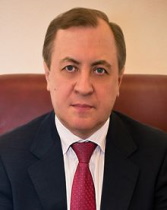
Born on July 23, 1957.
Director of the Institute of Technical Chemistry of the Ural Branch of the Russian Academy of Sciences - a branch of the Federal State Budgetary Scientific Institution Perm Federal Research Center of the Ural Branch of the Russian Academy of Sciences, Corresponding Member of the Russian Academy of Sciences.
Area of scientific interests
Strelnikov V.N. is a specialist in the field of developing fundamental principles for creating high-energy composite materials for special purposes.
Scientific achievements
Strelnikov V.N. was the first to study the processes and establish patterns that allow minimizing migration processes in charges of ballistic propellants of artillery shots, studied in detail possible ways to reduce migration processes and developed highly effective materials and coatings that ensure high reliability and operability of products during the warranty period of their operation.
He proposed a new approach to creating a combined catalytic system for regulating the ballistic characteristics of solid rocket fuels using modern achievements in the field of nanotechnology. This made it possible to make a significant contribution to solving the problem of reducing the dependence of the combustion rate on pressure for high-energy mixed fuels.
Under the leadership of V.N. Strelnikov and with his direct participation, a number of highly effective protective and fastening materials were developed for solid rocket propellant charges of rocket and space systems of various functional purposes, including for the engines of the Energia-Buran complex. In particular, he took an active part in the development of soft landing engines for fuel tanks and engines for separating the complex.
In addition, under the leadership of V.N. Strelnikov, research is being conducted and a new class of energy-dissipating nano- and microheterogeneous polymeric materials is being developed that provide effective protection of personnel, military equipment and structures from shock-wave effects during an explosion. It is shown that polymers with a complex nanophase structure such as polyurethanes and polyureas are a promising basis for the development of energy-dissipating materials. In this case, an additional increase in functional characteristics is achieved by creating heterogeneous elements in the structure of the material, providing additional absorption of explosion energy (the use of micro- and nanofillers, a combination of fibrous and powder fillers). As a result of the research carried out under his supervision, energy-dissipating composites with an operating temperature range of up to minus 60 C were obtained for the first time, and a high degree of attenuation (shock wave absorption) by energy-dissipating materials based on plasticized polyurethane urea was established.
He pays great attention to the training of highly qualified personnel, being the head of the department at the Chemistry Department at the Perm State National Research University. Under his supervision, 9 candidate dissertations were defended.
Strelnikov V.N. carries out extensive scientific and organizational work. For more than 15 years, he was the chief scientific secretary of the Perm Scientific Center of the Ural Branch of the Russian Academy of Sciences, to the creation and development of which he made a great contribution.
Membership in organizations
Strelnikov V.N. – Deputy Director of the Perm Federal Research Center (PFRC) of the Ural Branch of the Russian Academy of Sciences for scientific issues,
Member of the Joint Academic Council for Chemistry and Materials Sciences of the Ural Branch of the Russian Academy of Sciences,
Chairman of the Council for Chemistry and Materials Sciences of the PFRC of the Ural Branch of the Russian Academy of Sciences,
Heads the Dissertation Council DS 004.001.02 of the PFRC of the Ural Branch of the Russian Academy of Sciences and the Academic Council of the Institute of Technical Chemistry of the Ural Branch of the Russian Academy of Sciences – a branch of the PFRC.
Strelnikov V.N. is the author and co-author of more than 200 scientific papers, including 5 monographs and 18 author's certificates and patents.